Press Release – Exhibition Beyond Surrealism at the Depot of Museum Boijmans Van Beuningen
Six international artists reinterpret surrealist themes and connect their own work with collection pieces
png
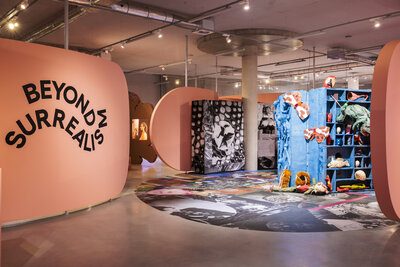
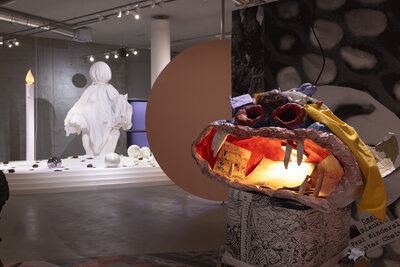
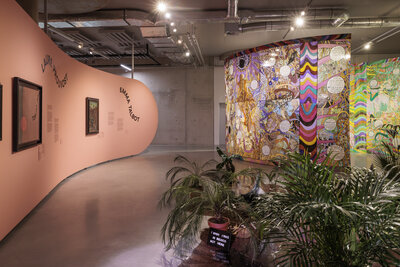
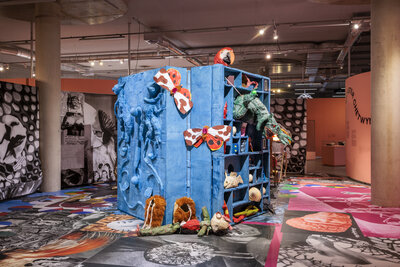
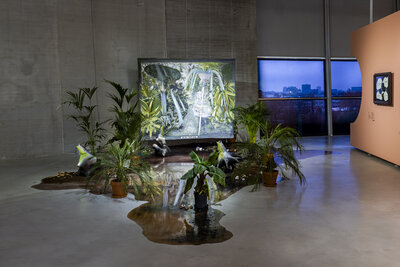
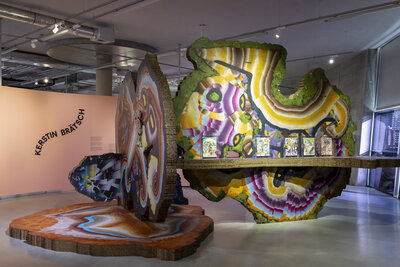
What happens when six contemporary artists are invited to unleash their imagination on a museum collection? Which works and themes resonate with them? The result will be on view until 6 April 2026 at the Depot of Museum Boijmans Van Beuningen, as part of the exhibition Beyond Surrealism. With a rich surrealist collection and a long-standing tradition of leading exhibitions, the museum has been closely connected to surrealism for decades. Beyond Surrealism builds on this legacy with a fresh perspective. Renowned artists — Kerstin Brätsch (1979), Monster Chetwynd (1973), Laure Prouvost (1978), Tai Shani (1976), Emma Talbot (1969), and Raphaela Vogel (1988) — engage in dialogue with the museum’s collection. Each selected one or more works and linked them to their own artistic practice. Beyond Surrealism invites visitors to look at the world with fresh eyes and shows how surrealism can offer new perspectives on contemporary themes such as identity, gender, feminism, and climate change.
A dream collection
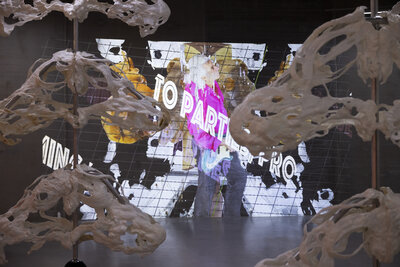
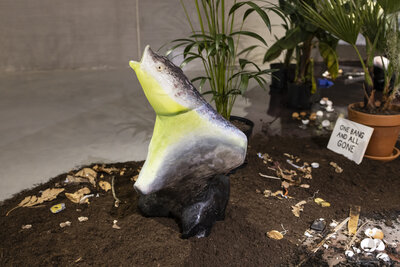
Museum Boijmans Van Beuningen has a rich surrealist tradition — from collecting iconic works by Salvador Dalí, René Magritte, and Max Ernst, to organizing major exhibitions such as Salvador Dalí (1970–1971), the first European retrospective of the celebrated Spanish surrealist, and Mad About Surrealism (2017). Now, 101 years after the publication of the first Manifeste du Surréalisme, six contemporary artists respond to the museum’s surrealist collection. In a specially designed 1000m² space within the Depot, they create a new reality. Some artists, including Talbot and Chetwynd, have developed entirely new installations in response to the works they selected from the collection. For the other four — Brätsch, Prouvost, Shani, and Vogel — various artworks have been loaned and integrated into installations created specifically for this exhibition. As a result, each of the six artists presents a newly conceived installation. Together, they demonstrate that reality is not a fixed concept, but a flexible construct that can be continuously questioned and reimagined.
Sources of inspiration
Kerstin Brätsch selected, among others, La reproduction interdite (1937) by René Magritte, while Monster Chetwynd chose Dalí’s Mae West Lips Sofa (1938). Laure Prouvost found connections with Peinture-poème (Musique, Seine, Michel, Bataille et moi) (1927) by Joan Miró. Tai Shani was drawn to Komposition (1955) by Unica Zürn. Emma Talbot selected a single work: Again, the Gemini Are in the Orchard (1947) by Leonora Carrington. Raphaela Vogel chose two beloved works by Dalí: Couple aux têtes pleines de nuages (1936) and Shirley Temple, le plus jeune monstre sacré du cinéma de son temps (1939). The last-mentioned artwork is rarely shown to the public due to its fragility.
Supporters
The exhibition was made possible with the support of the VriendenLoterij, Fonds21, the Cultuurfonds, Stichting Zabawas, the Swiss Art Council Pro Helvetia, Stichting Bevordering van Volkskracht, Stichting Elise Mathilde Fonds, Kring Van Eyck, Boijmans Business Club, Boijmans Bedrijfsvrienden, Stichting Museum Boijmans Van Beuningen with a contribution from the estate of Rine Coolen – Kalkman and Gemeente Rotterdam.
Zes internationale hedendaagse kunstenaars herinterpreteren surrealistische thema’s en combineren eigen werk met collectiestukken. Inspiratiebronnen zijn onder andere werken van Dalí, Magritte en M...
Wat gebeurt er als zes hedendaagse kunstenaars hun verbeelding mogen loslaten op een museumcollectie? Welke werken en thema's raken hen? Vanaf 15 november 2025 is het resultaat te zien in de tentoo...
Vanaf 1 november 2025 presenteert Museum Boijmans Van Beuningen Figure, Field, Grid van kunstenaar Mandy El-Sayegh. Dit is de eerste tentoonstelling in een nieuwe reeks Depot Solo. Kunstenaar Mandy...
Zaterdag 20 september 2025 gaan de deuren van het Depot weer wagenwijd open voor de jaarlijkse gratis Open Dag. Bezoekers kunnen tussen 11:00 – 17:00 uur meedoen aan verschillende rondleidingen, wo...
Ontvang het laatste Museum Boijmans Van Beuningen nieuws via RSS.